Showing posts with label Critique. Show all posts

March 08, 2015

Re-reading Chandler

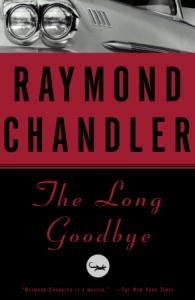
Some years after reading Raymond Chandler’s The Big Sleep and Farewell My Lovely, I thought it was about time I read his other most famous novel, The Long Goodbye. I had fond memories of the ‘reworking’ of the story in Robert Altman's 1973 film starring Elliott Gould and wondered how Chandler’s style would stack up against some of the modern crime writers I’d been reading in the last few years.
The Long Goodbye shows Philip Marlowe becoming involved in what appears to be two separate cases but which wind up being connected. The first is his growing friendship with Terry Lennox, who turns out, it seems, to be the murderer of his rich socialite wife. After the friendship ends with Marlowe driving Lennox to Mexico to escape a possible charge of murder, the second storyline picks up: Marlowe is hired by Eileen Wade, the wife of famous novelist Roger Wade, to find her husband, who is a drunk and has either gone off on a bender or is drying out somewhere in a sanatorium. These two plot-lines converge in more violence in which Marlowe is implicated but doesn’t participate.

May 31, 2013

Dan Brown's Inferno ... putting us all through Hell

I'm not going to write much about this because I don't want to give him the publicity he doesn't need (as if MY critique is going to have any impact!)

Put simply, this is a terrible book. The Da Vinci Code was badly-written but at least the plot was propulsive. The Lost Symbol was in the same vein and made you want to know what happened in the end. Inferno is just ... boring. I've been reading it for a week now and I'm only half-way through. There's no compulsion to finish it at all. I will, just to find out how it ends. But the 'big reveal' that Brown specialises in is already becoming clear, so there's no expectancy there. The main assassin is dead (like the albino monk in TDVC, but not as hardy). And to be honest I JUST DON'T CARE.

November 27, 2012

Lee Child - still reaching

In an alternative universe, I could have been Lee Child. We're almost exactly the same age and were brought up in Coventry. I suspect, however, that he's brighter than me. He got himself a job in TV production and when he was 'let go' he moved to America to write thrillers, which he's done to staggering success.

When you come across your first Jack Reacher book it's a hell of a ride. Reacher is logical to the nth degree and can think his way out of almost any situation. And when he can't, then he's 6'5" tall and has hands the size of plates - so he can batter his way out.

And that's it ... that's the plot of his last seventeen books. Reacher travels the country with a toothbrush and a credit card, buying clothes when he needs them, falling into dangerous situations every couple of months or so. He finds some bad guys and some good guys and makes everything OK. Crucially, these situations are usually somewhere out in the American sticks, where Child can create the world in which Reacher can move and have his being.

September 18, 2012

Is James Lee Burke the greatest crime writer alive?

Well I guess I've nailed my colours to the mast with that heading ... I am definitely a fanboy when it comes to James Lee Burke.

His latest book is Creole Belle, and continues the story of his bruised and battered cop hero, Dave Robicheaux and his friend Clete Purcel. In this instalment of their ongoing history, Dave is trying to find a girl who came to him while he was recovering from the wounds received at the end of the previous novel, The Glass Rainbow. He doesn't know at first whether the appearance of the girl was a medically-induced vision or whether she was in fact real. She leaves him an iPod with music already installed, but when others try to play the particular tracks on which she sings, they can't find them. This captures one of Burke's strengths - the ability to create an atmosphere in which reality and sur-reality intermingle. Robicheaux's consciousness is one in which the present and the historic past constantly mingle, so that his actions are always tinged with a recognition of their provenance in the past.

August 28, 2012

A chip off the old Burke?

Alafair Burke is the creator of two series of books featuring strong women - the Ellie Hatcher series and the Samantha Kincaid series. Never Tell belongs to the former, where Ellie Hatcher is a police detective in New York investigating the suicide - or was it murder? - of a young girl.

Like Peter Leonard in my post about his book, Burke labours under the weight of a famous writing father - in this case, James Lee Burke, one of the most celebrated authors - never mind crime authors - in the US. Where Leonard went into the past to escape comparison with his father's current work, Burke has traveled into the big city, thus separating herself from her father's association with rural Louisiana and Montana.

July 23, 2012

The game of the name - Peter Leonard's escape into the past.

Peter Leonard is the son of the Great Elmore Leonard, and in case we were in any doubt, there's an encomium from his dad as the preface to Voices of the Dead. In it, Leonard senior praises Leonard junior for having read his Ten Rules of Writing, especially the one about leaving out the parts that readers find boring.

Well, that's certainly true here. Voices of the Dead moves along like a steam train, barely pausing for breath (if a steam train breathes ... ). Set initially in 1971, it tells the story of Harry Levin, a Detroit scrap metal merchant, who finds himself hunting down an ex-Nazi who he remembers from the war, and who is still roaming the world killing Jews who might incriminate him. The story moves back to Dachau in 1942 for some key scenes that explain Harry's actions and give context, perhaps, for contemporary readers who don't know what went on in the concentration camps.

July 13, 2012

The Night and the Music: the seductions of Lawrence Block

Lawrence Block's The Night and the Music has a kind of finality to it that his many readers will be sorry about. Not a finality suggesting that he's about to hang up his pen, but that it might be closing time for his most famous creation, Matt Scudder.

Scudder is an ex-cop who gave up the Job when he accidentally shot a young girl while in pursuit of a felon. Since then he's lived on the edge of police-work by helping people out - sometimes people he knows; often those who know about him. He doesn't take a fee, but he does like his expenses to be covered. As he isn't a cop - and not even a licensed detective - he doesn't have the authority of the law behind him, so he has to grease a few palms or buy a few drinks. Or even 'buy a policeman a hat' - which appears to be slang for giving a cop 25 dollars in order to get some official info.

June 24, 2012

Come back to the raft ag'in, Sue Ellen ...

The American critic Leslie Fiedler wrote an essay called 'Come back to the raft ag'in, Huck Honey!', in which he suggested that much classic American literature contained a submerged theme of homoeroticism. He used Huckleberry Finn as an example of this kind of book, and Joe R. Lansdale's Edge of Dark Water seems to merge both of these texts, so that a trip by raft down river in a southern state of America fuses emerging sexuality, racial issues and death ... all wrapped around the story of a crime of passion.

June 04, 2012

What it Was - How it Is

Like Conrad's Heart of Darkness, the inspiration for Apocalypse Now, George Pelecanos' short novel What it Was is a tale told by a narrator who is partial though he appears objective. Conrad's narrator, Marlowe, tells the story of Kurtz, who ventures into the African jungle and meets himself, and his fate. The hero of What it Was, Derek Strange, tells the story of his own journey into manhood and responsibility.

Readers of Pelecanos will know Strange from previous books, first a trilogy where we met him as an older private detective working in Washington DC; then in Hard Revolution, a book set during the Washington Riots of 1968, when Strange was a street cop. Strange is perhaps well-named for, like Kurtz, he is an anomaly in his environment - a black cop in a largely white police force. Throughout the sequence of books he sees himself as an outsider, which allows Pelecanos to throw an objective light on the environment in which he works. In other words, we side with Strange and see the situations he encounters 'from the outside'. This is emphasized in What it Was by the fact that Strange narrates the book as a long story to his friend Nick Stefanos ... ironically another character in a separate series of books by Pelecanos.

May 28, 2012

He's all Hart

John Hart's Iron House is his fourth novel and seems to be a culmination of the stylistic tics he developed in the previous three.

Hart specializes in people under pressure, at the limits of their ability to cope with the rough stuff life has thrown at them. The stories usually play out in a sub-Tennessee Williams environment, where close family relationships are fundamental and nothing must be allowed to cast them asunder. In his first best-seller, The King of Lies the lead character has to discover who murdered his father and to protect his sister from accusations or murdering him. Similarly in Down River and The Last Child, the heroes struggle to protect their families or to find out 'The Truth' about what happened in the past. We're in the same territory in Iron House, with all kinds of family secrets being hidden and exposed, hidden and exposed, hidden and ... well, you get the picture.

May 22, 2012

A sweet mystery - Sandford's Stolen Prey

Stolen Prey is John Sandford's 22nd book about Lucas Davenport, an investigator with Minnesota's Bureau of Criminal Apprehension. All of the books have 'Prey' in the title, which distinguishes them from his other series about Kidd, a software expert and thief, and about Virgil Flowers, an investigator who actually works for Lucas Davenport but largely operates on his own.

The Prey books are masterly expositions of how crimes get solved through police procedure. Davenport is extremely bright and intuitive, but Sandford shows time and again how he uses police resources to find the bad guys. He has a researcher, he has street-level snitches, he has friends in High Places. And he uses all of these to provide him with information that he synthesizes to arrive at his deductions and leaps of imagination. What's more, Sandford shows how cops talk to each other - exchanging information, building up their view of the case, sniping at each other or just bantering.

April 29, 2012

Unbroken Excellence

Some crime writers are very obvious: there's a crime, an investigator, a criminal and finally a solution that includes a resolution. The prose takes you along briskly with perhaps some incidental commentary on society or the immediate environment in which the story is taking place. The investigator is brave, wry, cynical.

Then there are crime writers who are not obvious, but tangential: the originating crime is perhaps minor, the criminal is unclear, the solution doesn't really offer a resolution. And the investigator is uncertain, not brave, and not particularly cynical. The story emerges piece by piece, because the investigator is dogged and shrewd and is good at pattern recognition. Martin Cruz Smith with his Arkady Renko books has been, for me, the chief architect of this type of crime novel. But there are times, as in Wolves Eat Dogs, when it's hard to know exactly what has happened - the storytelling is so tangential as to be obscure. You have the sense that you're reading something good, even excellent, but you also think you must have missed something and have to go back to check up.

Peter Temple's The Broken Shore is another first-rate entrant into this sub-genre, with a style that is also tangential in the way it accumulates detail but is crystal clear in its use of imagery, character and dialogue.

April 23, 2012

Defending the Indefensible

William Landay's Defending Jacob is a very odd book. Narrated in the first person, it tells the story of an Assistant District Attorney whose son, Jacob, is accused of murdering a fellow pupil at school. The form of the book is that the narrator, Andy Barber, is providing some kind of deposition before a Grand Jury. The narration moves from him answering questions in making the deposition, to a straightforward first-person voice.

This sets up an odd situation for the reader - there are stretches of prose where this first-person voice is telling us the story ... and this is suddenly interrupted as we're whisked back into the courtroom:
The cop hesitated, appealing to Duffy with his eyes. Why waste time?
"We do it again,” Duffy repeated. “Like the man says.”
Mr. Logiudice: They never got the chance, did they? The detectives never got back into the interrogation room with Leonard Patz that day.
Witness: No, they did not. Not that day or any other day.
Mr. Logiudice: How did you feel about that?
Witness: I thought it was a mistake...

April 13, 2012

Greeneland

Graham Greene's The Ministry of Fear (1943) was written in the middle of World War II and is filled with very specific detail of what it was like to be living through the blitz. The central character, Arthur Rowe, finds himself accidentally caught up in some kind of (ill-defined) Nazi plot and spends most of the book trying to find out exactly what is going on around him. His confusion is compounded after a bomb explodes close to him, producing several weeks of amnesia, a period during which he is spoken to and treated as though he were someone else.

Greene is celebrated for his creation of what people have punningly called 'Greeneland', an odd melange of real geography and an unknown spiritual terrain. His characters travel not only through real places, accurately described, but through memories, dreams and psychological habitats. In The Ministry of Fear these journeys are evident and almost crude, as Greene is here writing one of his 'entertainments', books intended to garner sales rather than critical kudos. As a result, the internal journeys are externalised - Rowe's voyage to discover himself, and the hero he wants to be, is rendered through action as well as internal dialogue. His passage is physical as well as psychological.

April 08, 2012

Entertaining Mr Greene

I've started reading Graham Greene's The Ministry of Fear, one of his so-called 'entertainments' (as opposed to his serious works, I suppose).

I'm reminded very much of Conrad's The Secret Agent so far. I think it's the prosaic nature of the London life described by both Greene and Conrad, together with the larger-than-life characters who are Hitchcockian in their secrecy and the sense of foreboding that they bring. It's something to do with the way they say one thing while seeming to imply another, as if their personalities, if not their whole lives, are simply a front that you're supposed to take at face value without questioning what goes on behind. In the case of both of these books, that's rather true in that they're both about conspiracies in which 'ordinary' people are involved - again, as in many of Hitchcock's films.

I've just remembered that when I was at Sussex University I took an option and studied Conrad under Professor Cedric Watts. At the time, he was helping Norman Sherry research and write his multi-volumed biography of Greene. And looking at Sherry's books on Amazon I see that he's actually edited many of Conrad's books. So perhaps there's more similarities between Conrad and Greene than I had thought ... Hmm, I feel a learned paper coming on ... quick, nurse, the screens ...

April 06, 2012

Plod the policeman

In the UK, 'the Plod' is sometimes used as shorthand for the Police, presumably because they're seen as deliberate, slow-moving, conscious of detail: plodders.

Well that could certainly be used to describe Maj Sjöwall and Per Wahlöö's homicide squad in Roseanna, their first novel in the Martin Beck series, published in 1965 in Sweden and translated into English a couple of years later.

The plot revolves around the discovery of a dead girl in a canal in Borenshult. She is naked and there's no way of identifying her. The story then shows the slow process undertaken by Beck and his squad to identify her and find the killer. Unlike many contemporary crime novels, the investigation takes place over several months.

This is both the strength and the weakness of the book.

April 01, 2012

Swedish beginnings

I'm reading Roseanna at the moment, a crime novel by the Swedish partnership of Maj Sjowall And Per Wahlöö. It was written in 1965 and is dated to some extent (no DNA, no computers, international telephone calls a nightmare ... ). I'll write about it later, but coincidentally my colleagues at Mysterytribune.com have also posted on this couple and their books:


Sjowall and Wahloo

March 21, 2012

Chandler and Hammett

On the left of the blog there's a new link to a longish article on Chandler and Hammett, two of the giants of American crime writing. This is largely the text of a talk I gave to a literary group here in France, in Montmorillon, the Cite de l'Ecrit. The article looks at what Chandler and Hammett did to create the private eye genre and suggests some reasons for why detective and crime fiction has become so popular since they were writing.

Reading their books now is a strange experience because they're both very lively and their plots - especially Hammett's - are amazingly complex. There's no doubting, however, that the social context has changed dramatically and that some of the attitudes and prejudices of the writers - and their detectives - are uncomfortable for modern readers. Because we identify so strongly with Philip Marlowe and Sam Spade, when we see them demonstrating prejudices that we don't like, it's hard to stomach. We have to put it down to 'changes in society' ... but that seems somehow to diminish them.